
Bayesian Optimization vs. Classical Design of Experiments for Medium Optimization
Introduction
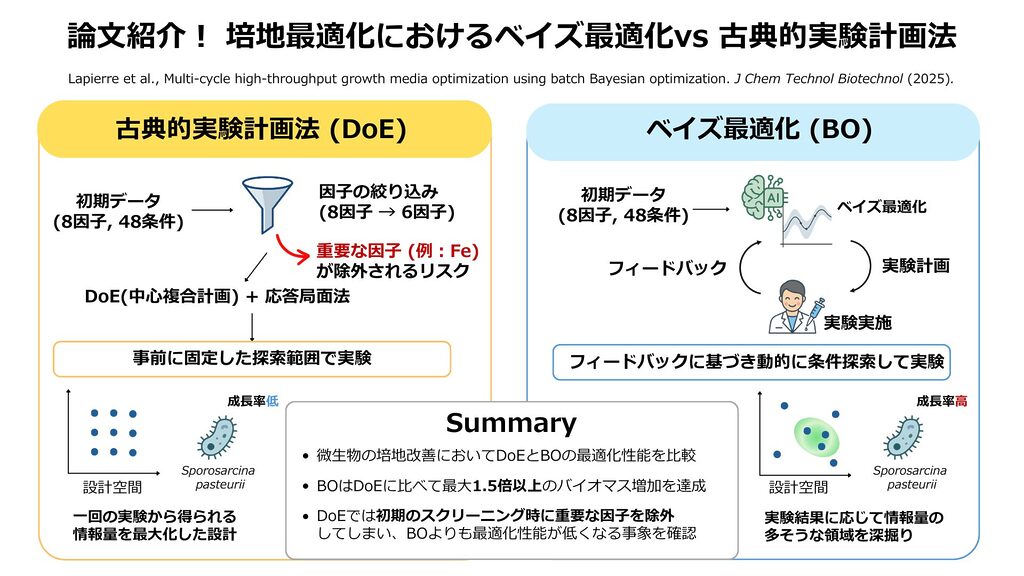
In the field of cell culture, medium composition has a significant impact on final productivity. Design of Experiments (DoE) has long been the standard optimization method, while Bayesian optimization has recently gained traction as a more efficient approach, with an expanding range of applications. The key difference between the two lies in their fundamental approach: DoE outputs combinations of conditions designed to efficiently evaluate the effects of factors within a range predetermined by the researcher, whereas Bayesian optimization is a feedback-driven, sequential optimization method that iteratively explores conditions likely to yield better results based on previous experimental outcomes. As modern life science research becomes increasingly sophisticated, there are growing cases where the optimal medium composition lies outside the bounds of existing knowledge and intuition. Consequently, efforts to replace conventional DoE-based condition screening with Bayesian optimization have been intensifying.
However, when considering an actual process transition, the key questions are: (1) how large is the performance gap between the two methods, and (2) how much improvement can the existing process achieve through the transition? In this article, we introduce a study that directly compared DoE and Bayesian optimization for medium optimization.
The paper featured in this article is:
Lapierre, F.M., Mattaliano, P., Raith, D., Castillo-Cota, M., Bermeitinger, J. and Huber, R. (2025), Multi-cycle high-throughput growth media optimization using batch Bayesian optimization. J Chem Technol Biotechnol, 100: 1571-1583. https://doi.org/10.1002/jctb.7860
Summary of the Paper
- This study compared conventional DoE and batch Bayesian optimization (BBO) as medium optimization methods for enhancing cell growth and productivity.
- Using Sporosarcina pasteurii as the model organism, they evaluated medium composition optimization performance. As a result, BBO achieved up to more than 1.5-fold biomass increase compared to DoE.
- BBO was shown to optimize media more flexibly and effectively than DoE by exploring and exploiting complex substrate interactions. In particular, cases where components deemed “non-significant” by DoE turned out to be limiting factors highlighted the limitations inherent in DoE screening methods.
Key Takeaways from This Article
- BBO and DoE can yield different optimization outcomes even for the same task.
- You will understand the advantages and practical significance of BBO compared to DoE in the context of medium optimization.
- BBO-based medium improvement is applicable to all biological species, including microorganisms, CHO cells, and stem cells.
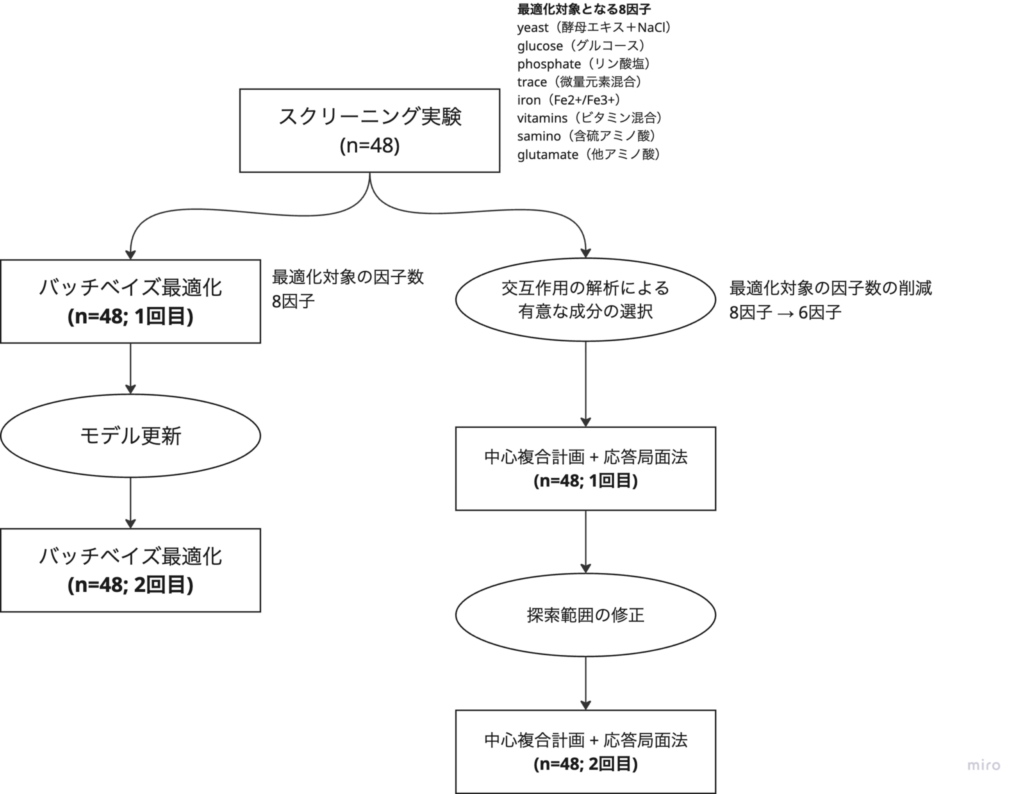
The experimental design of this paper is as follows (Figure 1)
- Medium optimization was performed for the bacterium Sporosarcina pasteurii, also known as a host for biocement production.
- The medium to be optimized consisted of 8 factors.
- In the initial screening experiment, 48 conditions were evaluated.
- Subsequently, the following two methods were compared:
- DoE (Central Composite Design: CCD) + Response Surface Methodology (RSM): To make the search space more manageable through interaction analysis, factors were reduced from 8 to 6.
- Batch Bayesian Optimization (BBO): Using the 48 conditions from the initial screening as initial data, optimization was performed on all 8 factors.
Results
The following differences were observed in the optimization performance of both methods (Figure 2).
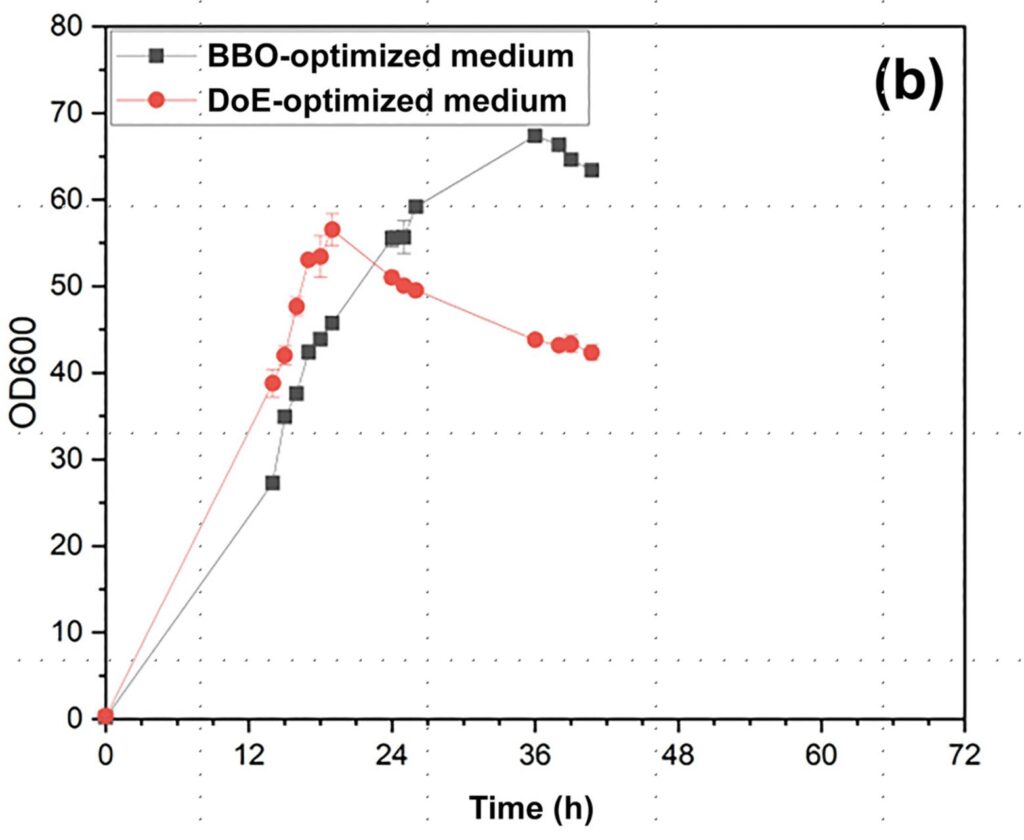
As a result, the medium designed by Bayesian optimization showed more than 1.5-fold higher performance.
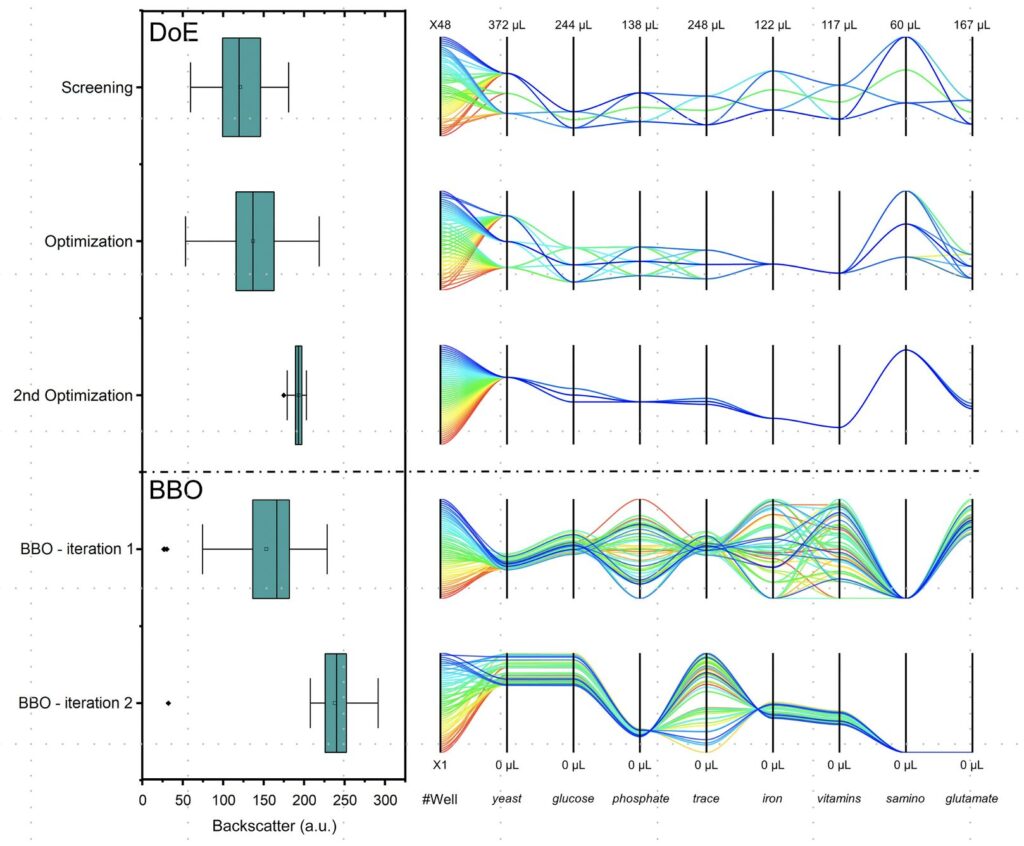
Even with the same number of trials, BBO targeting 8 factors achieved superior results compared to DoE with factors reduced to 6. This demonstrates the potential of Bayesian optimization as an optimization method. Furthermore, the distribution of medium compositions explored by both methods (Fig. 3) was also contrasting.
- DoE-based media: Fe content was fixed
- Bayesian optimization: Fe concentration was included in the search space
In DoE, as the number of factors increases, the required number of experiments grows rapidly, so important factors are selected through preliminary screening. In this study, Fe was excluded from the optimization targets during that process. In contrast, Bayesian optimization continued its search without reducing the number of factors, and as a result, conditions including Fe were selected.
Why did DoE miss this important factor? The authors point out that “applying a DoE model unconditionally can lead to suboptimal results.” Even when a certain element does not appear to be a limiting factor in the initial screening stage, as optimization progresses and biomass increases, that element can emerge as a new limiting factor. This suggests that Bayesian optimization, which can generate the next experimental conditions while providing feedback on the changing cell state, may be more effective as optimization advances.
This study demonstrates that, as hypothesized, over-reliance on existing knowledge and initial screening can lead to missing important factors, thereby constraining optimization performance. Since factor interactions change nonlinearly during the optimization process, accurate prediction at the initial stage is difficult. The advantage of Bayesian optimization lies in its ability to continue data-driven exploration without narrowing down factors.
In this experiment, factor levels were set using statistical methods, but in practice, they are often designed based on domain expertise and empirical rules. If those assumptions are incorrect, significant performance differences can arise. This issue is expected to become more pronounced as the number of factors and levels increases. While this study focused on microbial optimization, this framework is generalizable across biological species. In fields of growing market importance, such as antibody therapeutics and cells for regenerative medicine, applying this approach to culture condition optimization is expected to deliver significant value. In fact,
Cosenza, Z., Astudillo, R., Frazier, P. I., Baar, K., & Block, D. E. (2022). Multi-information source Bayesian optimization of culture media for cellular agriculture. Biotechnology and Bioengineering, 119, 2447-2458. https://doi.org/10.1002/bit.28132
reported that for mouse-derived C2C12 cells, Bayesian optimization enabled medium design that yielded 181% more cells at equivalent cost. As such, Bayesian optimization is attracting attention as a means to dramatically improve cell culture efficiency, and its widespread adoption appears to be an inevitable trend.
Related Articles
Introduction to Bayesian Optimization for Medium Components (Batch Optimization)
We present a practical implementation of batch Bayesian optimization and explain the trade-off between search accuracy and experimental efficiency through a comparison with sequential optimization.
Introduction to Bayesian Optimization for Medium Components
Using a function that simulates cell behavior in response to medium component concentrations, we explain the sequential optimization approach of Bayesian optimization and illustrate the expected results with a Python implementation.